

Do you constantly feel like you have a urinary tract infection (UTI), but your urine tests keep coming back negative?
Many women experience frequent urination, urinary urgency, and bladder pressure despite having no infection. Some undergo repeated testing, including cystoscopy, and may eventually be diagnosed with interstitial cystitis (IC), also known as bladder pain syndrome.
But what if your bladder isn’t the actual problem?
The answer may lie in the veins surrounding your bladder.
How Can May-Thurner Syndrome Affect Your Bladder?
Your pelvic veins carry blood from your pelvis and legs back toward your heart.
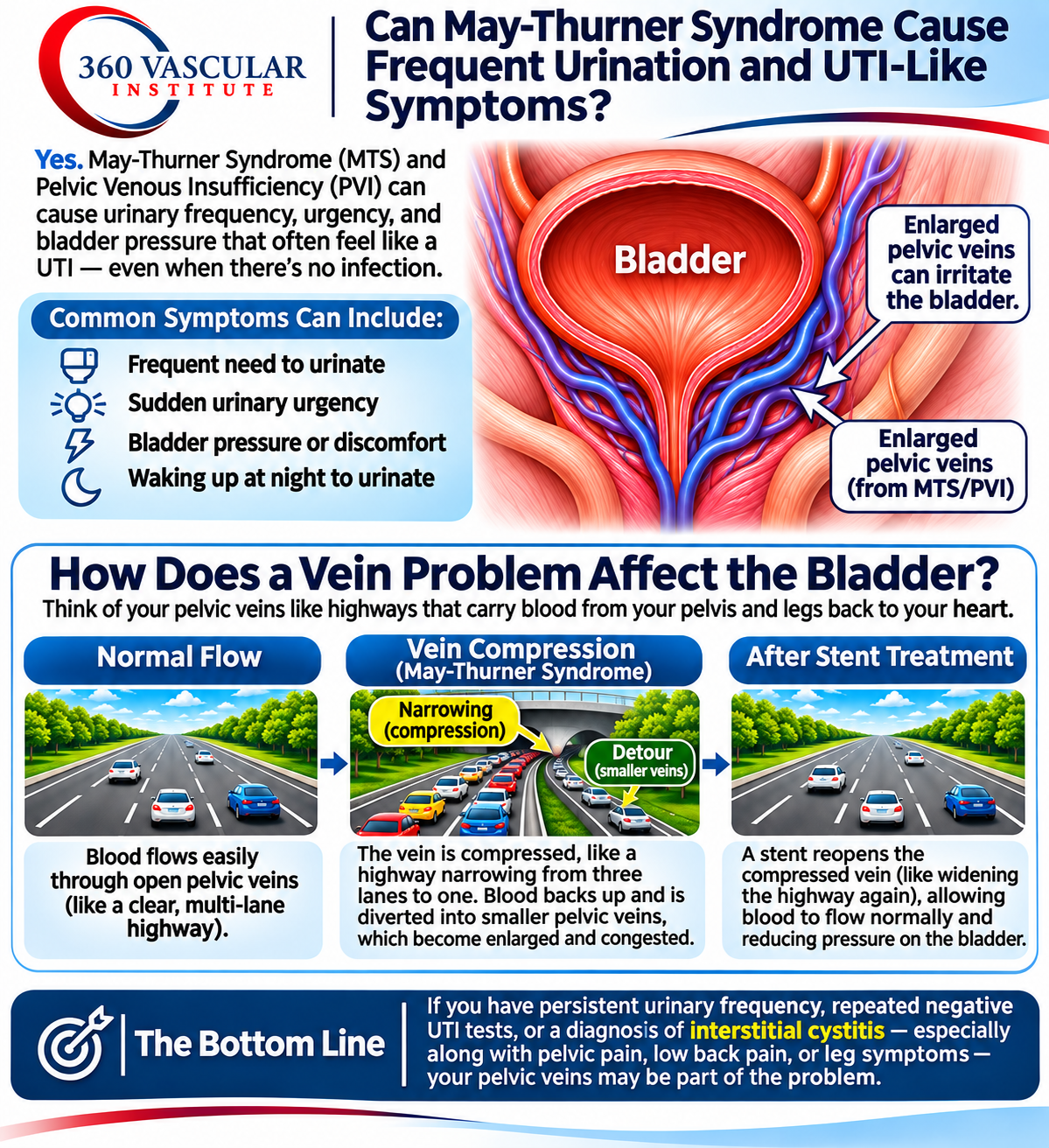
Think of these veins as highways. In May-Thurner Syndrome (MTS), the left iliac vein becomes compressed, much like a three-lane highway suddenly narrowing to one lane.
Traffic backs up, forcing cars onto smaller side roads.
The same thing can happen with blood. When blood has difficulty flowing through the compressed vein, it may be redirected into smaller veins in the pelvis, causing them to enlarge.
Here’s why this matters.
Some of these veins are located around your bladder. When they become enlarged and congested, they may contribute to bladder irritation and pressure, making you feel like you constantly need to urinate—even when your bladder isn’t full.
This can cause symptoms that feel remarkably similar to a UTI, including frequent urination, urgency, and pelvic discomfort.
Can Treatment Improve Urinary Symptoms?
In some patients, yes!
When May-Thurner Syndrome causes significant venous obstruction, a small metal stent can be placed inside the compressed vein to improve blood flow.
Think of it as reopening the main highway. Blood can flow more easily, reducing the need to travel through those smaller pelvic veins.
As pelvic venous congestion decreases, urinary frequency and urgency may improve significantly.
However, not everyone with urinary symptoms has MTS, and not everyone with MTS needs a stent.
The Bottom Line
If you have persistent urinary frequency, repeated negative UTI tests, or a diagnosis of interstitial cystitis—especially along with pelvic pain, low back pain, or leg symptoms—pelvic venous disease may be an overlooked contributor.
At 360 Vascular Institute, we specialize in diagnosing and treating May-Thurner Syndrome and Pelvic Venous Insufficiency.
Sometimes, the problem isn’t the bladder itself. It’s the veins surrounding it.


