Every day millions of people worldwide struggle with chronic pelvic pain, leg swelling and pain, leg fatigue and heaviness, varicose veins, and skin changes. Many seek care from vascular specialists hoping that procedures such as vein ablation, iliac vein stenting, and other procedures will quickly fix the problem. Your doctors want relief for you just as much as you want it for yourself. However, there is a compassionate truth that must be shared:
There is no vascular procedure that can overcome the ongoing pressure of excess weight and inactivity.
This blog post is NOT about blame. Weight loss IS hard. Lifestyle change is hard. Your physician wants to see you succeed in improving your health which is why honesty matters.
How Extra Weight Overwhelms the Veins
Your leg veins must push blood upward, against gravity, to return it to your heart. When a patient is overweight or obese, especially with weight carried in the abdomen and thighs, the veins face far more pressure than they were designed to handle. Over time, this leads to:
- Blood pooling
- Chronic swelling
- Valve damage
- Chronic pelvic pain
- Skin discoloration and ulcer risk
- Potentially life-threatening blood clots
One of the most serious complications of venous disease and another reason why weight management is so critical is the increased risk of blood clots or deep vein thrombosis (DVT). Excess weight also raises the risk of deep vein thrombosis (DVT). For this reason, weight reduction and mobility aren’t just about leg swelling—they’re also critical for preventing potentially life-threatening clotting.
⚠️ Note on Clot Risk:
Studies show that people with obesity may have 2 to 5 times the risk of developing DVT or a pulmonary embolism compared with those at normal weight.
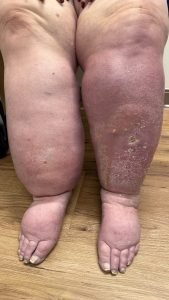
Why Vein Ablation or Iliac Vein Stents Alone Don’t Work
Vein ablation is the gold standard procedure for the treatment of chronic venous insufficiency (CVI). Iliac vein stenting is a procedure used in the treatment of May Thurner Syndrome that commonly causes chronic pelvic pain and leg swelling. Both vein ablation and iliac vein stenting can be remarkably effective in the right situation. But when severe weight-related pressure and swelling remain, these procedures cannot deliver the results patients hope for. That is because:
- Gravity continues to win
- The lymphatic system becomes increasingly overwhelmed
- External pressure (from excess intra-abdominal fat) continues to collapse or stiffen the veins
- The calf-muscle pump cannot function without movement
Performing procedures without addressing obesity is like draining a flooded basement while the water is still pouring in. The root cause hasn’t changed, so the outcome doesn’t change. This is true even for patients who are not morbidly obese but simply overweight. The more pressure the veins face, the less successful any procedure will be.
For patients who are 300–500 pounds or more, the pressure is so great that procedures often provide little to no improvement. The physics of blood flow make it impossible for the veins to recover under that stress.
Overcoming the Sedentary Trap
Even at a healthy weight, veins cannot heal without movement. If a patient has a procedure but remains sedentary (sitting or lying down most of the day), the calf muscle pump never activates, and swelling will persist due to venous blood pooling in other untreated veins.
Many patients find that support from family or friends makes all the difference in getting up and moving. Progress takes effort—sometimes discomfort—but each step toward exercise helps reduce vein strain and pelvic pressure. Remember: a little “no pain, no gain” can go a long way in improving health.
The Value of the Physician-Patient Partnership
When patients who are overweight or obese do get great results, it’s often not from the procedure alone — it’s because of the physician-patient partnership.
Personalized vascular care is more than just performing a successful procedure. It involves:
- An accurate diagnosis
- Creating a personalized treatment plan
- Perform procedures when appropriate
- Support and guidance for the patient and their families
The patient must:
- Commit to weight loss (even modest weight loss helps tremendously)
- Move daily to activate your calf muscle pump
- Follow compression and lifestyle recommendations
And most importantly…
Success requires support at home, which is why you should encourage your family members to attend your vascular consultation. When your loved ones understand your journey, your odds of success increase dramatically.
Physicians can improve (not cure) your vein disease — but we cannot do it alone.
There Is hope…
The good news is that small steps make a real difference. Losing even 10–20 pounds, adding short walks, and reducing sitting time can decrease venous pressure and make future procedures far more effective.
If it ever feels like your physician is focusing on your weight, remember the goal is never criticism. Your physician is here to guide, support, and celebrate each milestone, helping you take steps toward improved vascular health and a better quality of life.
El-Menyar A, Asim M, Al-Thani H. Obesity Paradox in Patients With Deep Venous Thrombosis. Clin Appl Thromb Hemost. 2017 Sep 7;24(6):986-992.